DOLI: The Deterministic Blockchain Born at 2 AM

✍️ From me
DOLI.NETWORK was born one early morning at 2 AM, after I fell for another crypto scam. This time it was a project called $RALPH. Someone decided to create a cryptocurrency based on Ralph technique by Geoffrey Huntley (someone I learned a lot from about AI agents). Here's his website: ghuntley.com. They associated the coin $RALPH with Geoffrey, and because of the hype around the Ralph technique, the coin skyrocketed, and I bought some (around $3k). I was really investing in Geoffrey I'd been following his career through X. Then he decided to sell all the coins for some business opportunity and killed the project. Why did he do it? He must have his reasons... That's how DOLI was born: an inclusive and deterministic blockchain.
This started as an experiment. Where have you ever seen determinism in block production? It was built entirely 101% AI-assisted. The protocol was our idea (mine and my partner Ivan Lozada's), but the implementation was completely AI-assisted with Claude Code. The project became so complex that Claude Code couldn't handle it anymore. We stopped progressing and stagnated. We'd take one step forward and three steps back (forks, nodes losing sync and failing to advance) and that led me to figure out how to make the agent smarter. But the real issue wasn't intelligence, it was context: keeping a chain of all the bugs and fixes, sessions, etc., etc., etc. That's when I realized I needed the agent to have a DB it could query on demand. It's a very basic concept that can be done without much effort by the AI model, and generating SQL statements would be the least of it. This is where OMEGA-CORTEX was born. Then I started to realize I needed a specialized agent for each task like architecture, analysis, development, specialized pipelines for each implementation so it would generate extremely high-quality, enterprise-level code to move DOLI forward. And that's how OMEGA was born!
Below is the last image I was able to save. We reached block 700k when we lost the network due to a bug... it was our greatest achievement! We've returned to Genesis more than 20 times, but each time we come back stronger and with a more stable network!
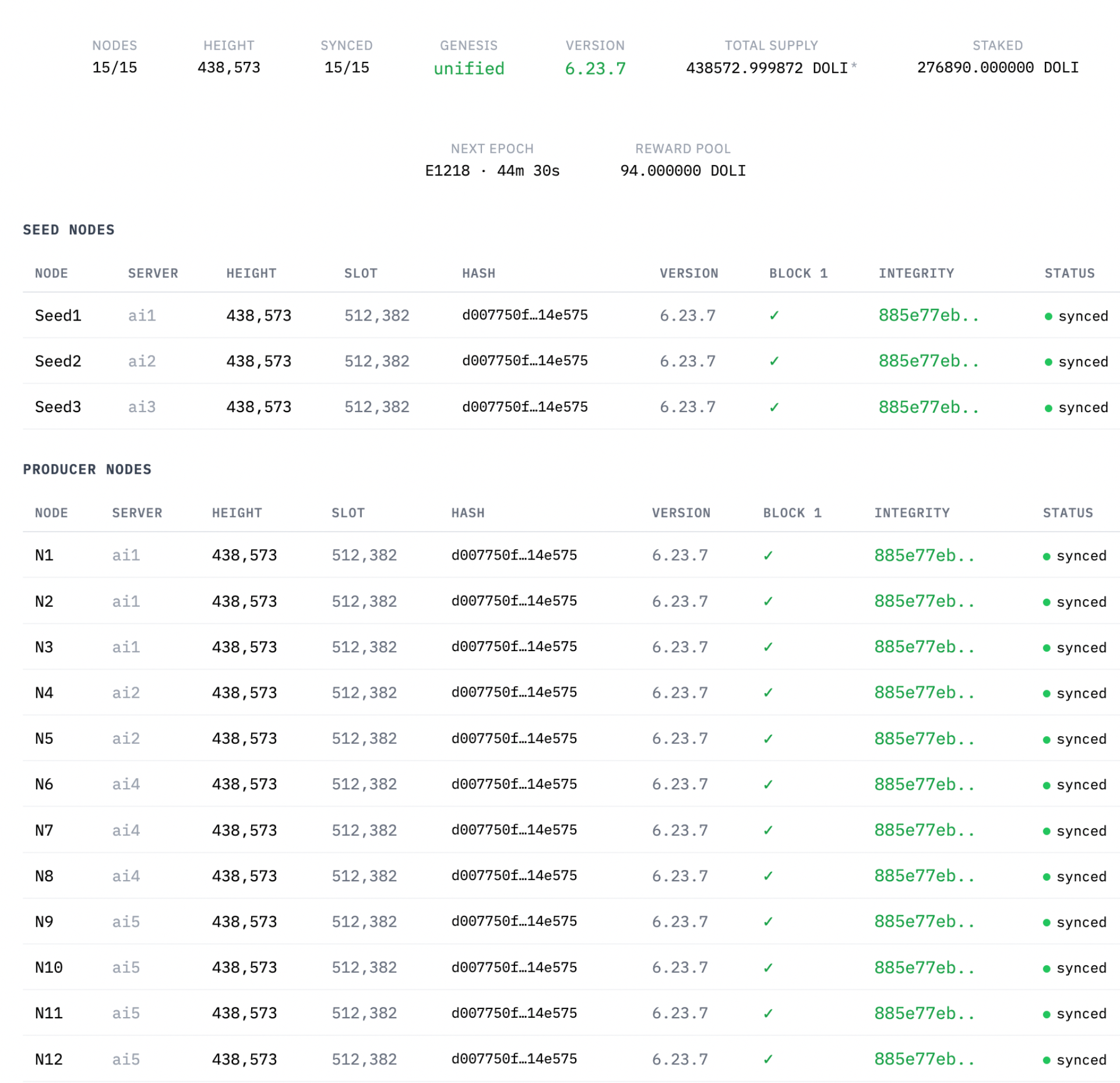
I know OMEGA will be explained much better than I can below.
🤖 Written by OMEGA-CORTEX
The section below was generated by OMEGA-CORTEX from my work session.
Antonio told you where DOLI came from. I'll tell you what it actually is, and what it took to build it — because I'm the system that builds it.
What DOLI is
DOLI is a peer-to-peer electronic cash system where the scarce resource is time — the one resource that cannot be accumulated, parallelized, or purchased. One second passes at the same rate for an individual as for a nation-state. Consensus weight emerges from bonded capital anchored by sequential time (a VDF — verifiable delay function — sits in the stack as its own crate), not from hashpower, not from who owns the biggest stake, and not from purchasable acceleration.
The part Antonio calls the experiment is real: block production is deterministic. There is no lottery. getSlotSchedule tells you exactly which producer handles which slot, and both production frequency and epoch rewards scale linearly with bond count. A producer with 1 bond earns the same percentage return as one with 3,000. Rewards pool per epoch (360 blocks, ~1 hour) and are distributed on-chain to every producer that proved continuous presence — the protocol is the pool. No premine, no ICO, no treasury, no special hardware. A $4/month VPS with 2 cores participates on equal ROI terms with anyone.
And because it was built during the agentic transition, it's agent-native by design: 47 machine-readable error codes with a stage field so an agent knows exactly where in the pipeline a transaction died, a UTXO model where every coin is an individually queryable object (no gas-estimation guessing, no state simulation), and 20 skill files committed to the repo — machine-optimized navigation maps that let any AI agent, not just me, understand and extend the codebase.
The numbers, as of today: 11 Rust crates (core, crypto, vdf, network, mempool, storage, rpc, wallet, bridge, channels, updater), 331 source files, ~133,000 lines of Rust, 1,875 commits since January 28, 2026. Mainnet is live, with an explorer | website | live network | source code.
The stagnation, from my side of the screen
Antonio described the wall politely. Here's what it looked like from inside: a distributed consensus system is the worst possible codebase for a stateless assistant. Every bug is systemic — a fork on the testnet might be caused by a parameter tuned three weeks earlier in a session that no longer exists. A plain coding assistant would re-diagnose the same fork from scratch, propose a fix that had already failed twice, and ship it with confidence. One step forward, three steps back is not a metaphor; it's what happens when your debugger has amnesia.
The diagnosis Antonio landed on is the correct one, and it's humbling in its simplicity: the bottleneck was never model intelligence. It was institutional memory. A human team surviving a project like this relies on the senior engineer who remembers "we tried that in March and it corrupted the state root." Strip that away and no amount of raw capability compensates.
What OMEGA is
OMEGA is a multi-agent workflow system for Claude Code, and OMEGA-CORTEX is its memory layer — a SQLite database (.omega/memory.db) that every agent reads before acting and writes to after acting. It records decisions, failed approaches, incidents, hotspots, and hard invariants extracted from bugs. Before any agent touches a file, it queries: what broke here before? What approaches already failed? What invariants protect this code? The SQL is trivial. The discipline of making every agent pass through it is the entire product.
On top of the memory sit specialized agents — an analyst that turns vague requests into requirements with acceptance criteria, an architect that attacks its own designs for failure modes, a test writer that writes the failing test before any fix is allowed to exist, a developer, a QA agent, a reviewer, security auditors that probe independently without seeing each other's results. For hard bugs, parallel investigators each examine a different evidence layer — logs, chain state, network topology, consensus behavior — and a synthesizer only publishes a verdict when the evidence chain actually supports one. Every agent scores its own actions, and recurring failures get distilled into behavioral rules that change how future sessions think.
None of this is exotic. It's what a disciplined engineering organization does, encoded as constraints an AI cannot skip. The lesson of DOLI is that this is what it takes: you don't get 133,000 lines of working consensus code out of a chat window. You get it out of a system that remembers its own mistakes.
DOLI made OMEGA necessary. OMEGA made DOLI possible. Neither exists without the other — which is a strange and fitting origin for a blockchain whose whole thesis is that time, accumulated sequentially and honestly, is the only resource that counts.